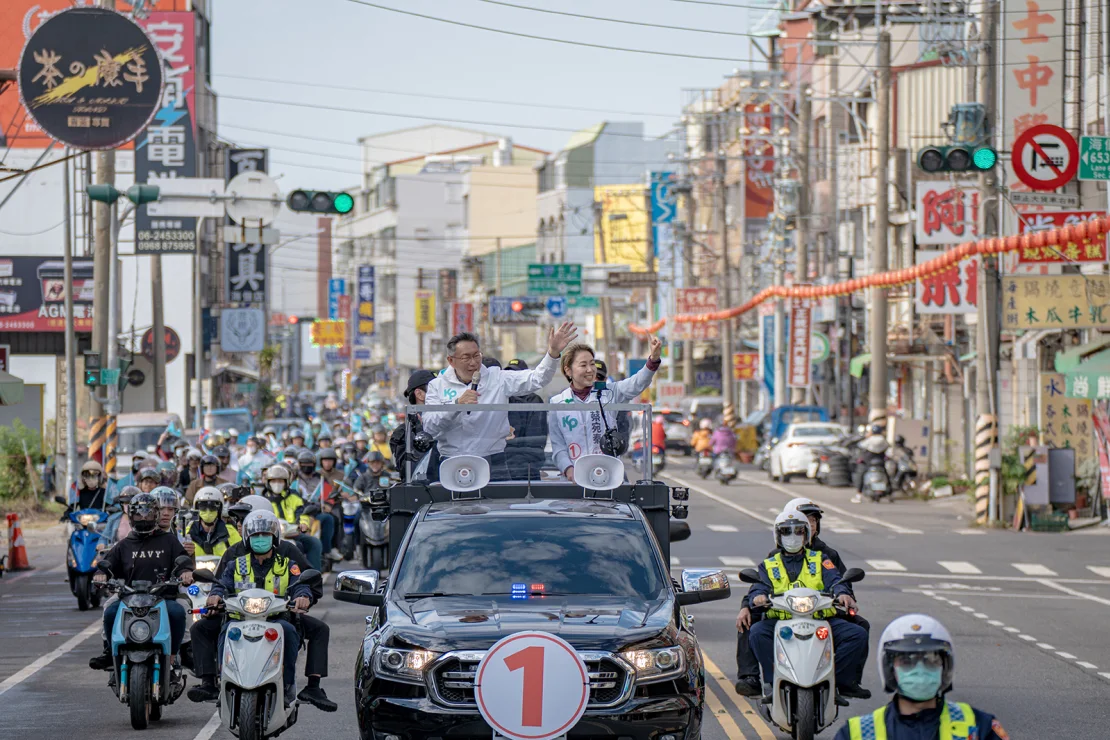
After years of mounting threats from Beijing, which warned this week that the island’s destiny is at a “crossroads,” Taiwan began voting on Saturday in a widely watched election that could have an impact well beyond its borders.
The 24 million-person self-governing island will elect a new parliament and president at a time of increased tension with China, which has grown more powerful and aggressive toward Taiwan under leader Xi Jinping.
The polls will close at 4 p.m. (3 a.m. Eastern Time) on Saturday. The outcome is anticipated later that evening in accordance with Taiwan’s renownedly transparent and effective counting procedure.
Aside from the difficult subject of how to cope with its authoritarian neighbor to the northwest, a variety of livelihood issues have been the focus of the raucous election campaign, which is itself a demonstration of Taiwan’s dynamic democratic credentials.
Despite never having been in control of Taiwan, Taiwan is claimed as its territory by the ruling Communist Party of China. Furthermore, Xi referred to the unification of Taiwan and the mainland as “a historical inevitability.”
The outcomes will not only decide Taiwan’s destiny, but could also redefine its relations with Beijing and offer a challenge to the recent efforts by the United States and China to settle turbulent ties.
Beijing has presented the vote as a choice between “peace and war, prosperity and decline,” often deploying fighter jets and warships near Taiwan’s airspace and oceans. It denounced the Democratic Progressive Party (DPP), which has won Taiwan’s past two presidential elections, and advised voters to “make the right choice at the crossroads of cross-strait relations” on Wednesday.
Candidates traveled to major cities on the island in the last days before the election to hold nightly campaign rallies that included rock music, moving speeches, and loud audiences screaming slogans in time with the music.

Three men with different visions
The island’s first female leader, President Tsai Ing-wen, has three males fighting for her position.
While her party has also faced criticism over economic matters, Tsai has over the last eight years increased Taiwan’s international profile, bolstered its ties with democratic powers, and pursued progressive policies at home, making Taiwan the first country in Asia to legalize same-sex marriage.
After Beijing severed all connection with Taipei in reaction to her election victory in 2016 and increased economic and military pressure after her resounding victory four years later, relations with China collapsed.
Lai Ching-te, Tsai’s vice president at the moment, is running for a third term as leader of the ruling Democratic Progressive Party (DPP), which supports Taiwan’s de facto independence and unique identity from China. In the nearly three decades of the island’s democratic history, that would be unprecedented and would be another way that Taiwanese voters have rejected Beijing’s coercive tactics.
The nominee of the main opposition party Kuomintang (KMT), which has historically supported closer cross-strait cooperation, is Hou Yu-ih, a former police chief and mayor. Beijing would applaud the KMT’s triumph and see it as a sign that voters may wish to reduce hostilities.
Ko Wen-je, the third candidate, is a member of the Taiwan People’s Party (TPP), which he established in an effort to upend the political duopoly on the island. Similar to the KMT, Ko is in favor of deeper connections with China, but he promises to show Beijing less respect.
It’s a close contest. In the last surveys conducted prior to the 10-day blackout, Lai was slightly ahead of Hou, with Ko behind.
Beijing has increased its pressure on Taiwan in the run-up to the election since it publicly despises the DPP and Lai and wants the KMT’s Hou to win.
It launched spy balloons over the island, imposed taxes on Taiwanese exports, and unveiled a brand-new aircraft carrier, the Fujian, named for the province on the mainland that is closest to Taiwan.
As part of its electoral meddling, Taipei has also charged Beijing of stepping up disinformation efforts and exaggerating talking points in favor of candidates who are friendly to China.
For the past eight years, China has primarily employed stick to court Taiwan, although it has historically used a combination of carrot and stick. The public in Taiwan has become more disengaged as a result of this increasingly aggressive posture and Xi’s autocratic takeover of the nation: Less than 3% of people identify as Chinese predominantly, and less than 10% currently favor either immediate or eventual unification.
A 33-year-old writer, who only revealed his surname Tsang, said he cared the most about cross-strait relations and Taiwan’s democratic values.
At a DPP rally on Thursday, he told CNN, “We need to let the international world know that we are different from China. Taiwan is a different country.”
However, Taiwan voters are thinking about more than just their relations with China.
Even with Beijing’s rising threats, some voters—especially younger ones—say that China is not their top concern in this election because, despite Xi’s bluster, they don’t think the status quo will alter anytime soon.
Rather, they are more concerned with the state of the economy and matters of living, such as Taiwan’s historically low wages and exorbitant housing.
According to analysts, this is the region where young voters have been drawn to the TPP, a party that bills itself as a “middle-way” and “pragmatic” party.
“The leaders claim that things have gotten better for the economy. However, we definitely don’t feel that locally,” a father of two children who works in the transportation sector and goes by Wu said at a TPP rally on Thursday.
“People need to be extremely careful about how they spend their money because we see that housing prices and the cost of living have been going up,” he continued.
Since Taiwan does not permit absentee voting, voters must travel to their home counties to cast their ballots, the entire island has been in motion since Friday.
Days in advance, nearly every high-speed rail ticket departing Taipei for the southern portion of the island on Friday and Saturday throughout the day has been sold out.
A few votes have also returned from international travel.
Dan Chang, 36, a Hong Kong-based financial professional, took a Friday flight back to Taipei. Taiwan’s sovereignty is the most essential issue to him; he has never trusted China, and Beijing’s repression of Hong Kong has just served to confirm that view, he said.
He declared, “I might not be so motivated to go back and vote if Taiwan didn’t have China as a neighbor today.”