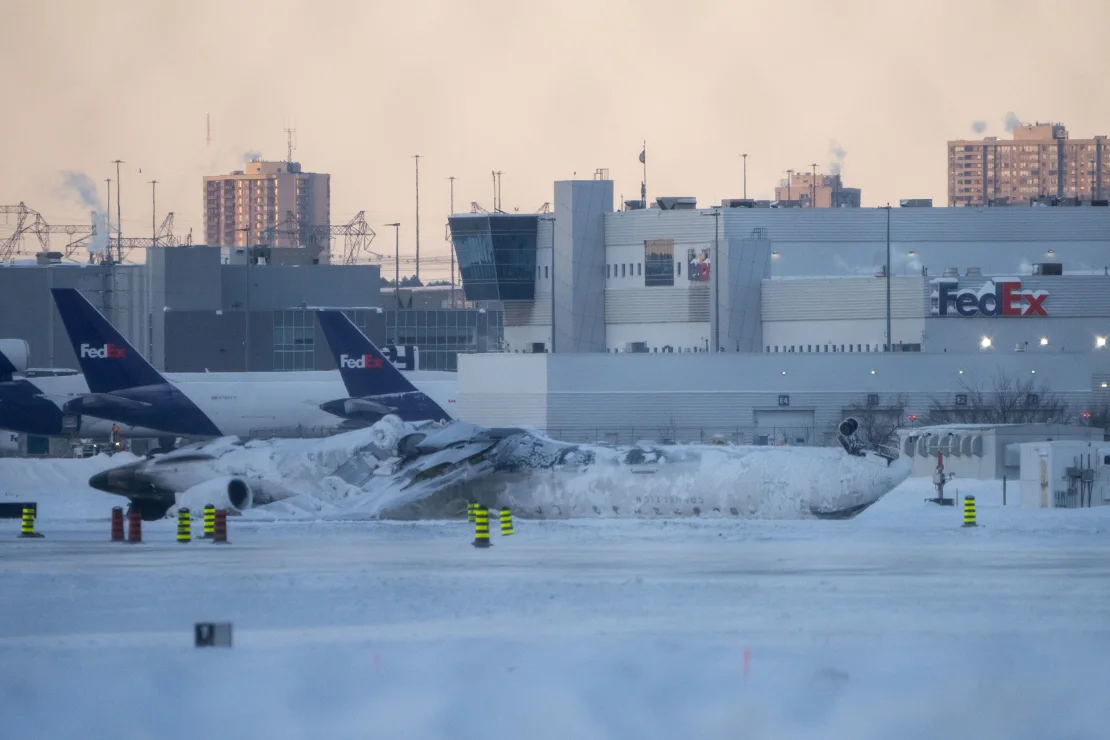
The most recent in a series of passenger airline catastrophes since December occurred Monday when a Delta Air Lines flight from Minneapolis crashed, turned upside down, and caught fire on the runway at Toronto Pearson International Airport while it was trying to land.
According to a statement from Delta, all 80 passengers on board the CRJ900 twin-jet aircraft survived, however 21 were hospitalized for injuries. As of Tuesday morning, Delta reported that everyone but two had been discharged from the hospital.
The airplane landed hard on the runway, causing the right wing to break away in a fireball and the rear landing gear to buckle, according to footage CNN was able to get.
Smoke and snowflakes fly into the air as the plane slides on its belly for a brief moment before flipping over.
“Oh, no, no, no, no!” exclaims the videographer, who is observing from inside another aircraft close to the runway.
“It was really rough when we hit. John Nelson, a traveler, stated, “It’s amazing that we’re still here,” after the jet turned sideways after hitting the ground.
On Monday night, Nelson told CNN, “I still smell like jet fuel.”
By Tuesday afternoon, the wreckage of the jet was hardly distinguishable, with its right wing missing and its left wing bent, while snow covered the frozen fuselage, making it blend in with the surroundings.
The crash on Monday is the most recent event in a year that has seen many fatalities in North American aviation travel. A tiny airline plane crashed in Alaska earlier this month, killing ten people.
A US Army Black Hawk helicopter and an American Airlines aircraft collided in midair near Washington, DC, less than three weeks ago, killing 67 people. A medevac jet crashed in Philadelphia two days later, killing one person on the ground and all six others on board.
Deadly collisions in South Korea and Kazakhstan in December preceded those tragedies.
All 80 passengers and crew members made it out alive.
Around 2:15 p.m. ET on Monday, Delta Flight 4819, which was operated by Delta subsidiary Endeavor Air, took off from Minneapolis/St. Paul International Airport and crashed at the airport, which is primarily in the Mississauga area west of Toronto, according to a statement from Delta.
“Today’s incident at Toronto-Pearson International Airport has touched the hearts of the entire Delta family worldwide,” stated Ed Bastian, CEO of Delta. “I would like to thank the first responders on the scene as well as the numerous Delta and Endeavor team members.”
“The professionalism of the Endeavor crew members who evacuated the aircraft, along with the first responders at Toronto Pearson International Airport and the airport leadership team, is something I’m extremely proud of,” Bastian continued in a memo to Delta employees that was acquired by CNN Tuesday.
The president and CEO of Toronto Pearson International Airport, Deborah Flint, also gave first responders’ “textbook response” credit for preventing fatalities.

Passengers were “upside down hanging like bats” after the hard landing.
One of the passengers, Pete Koukov, claimed that until they touched down, he “didn’t know anything was wrong.”
Koukov told CNN’s Brianna Keilar, “We hit the ground, and we were sideways, and then we were upside down hanging like bats.”
His “whole window just turned into flame briefly and then it was dark as we slid,” according to Nick Costigan, who talked to the Toronto Star. He told the site that after the plane halted, it was “weirdly” quiet.
Another passenger, Pete Carlson, an executive at a Minneapolis health care company, told CNN newsgathering partner CBC, “I took off my seat belt, which I’d obviously left fastened for the landing, and as I took it off, crashed down on to the ceiling which had become the floor.”
According to Cory Tkatch of Peel Regional Paramedic Services, paramedics who attended to the collision treated a variety of ailments, including head cuts, back sprains, and nausea brought on by jet fuel fumes.
The typical “flare” of the aircraft, in which the pilot raises the nose up shortly before landing, exposing the wings to increased air resistance, does not appear to be seen on video of the disaster.
Former Department of Transportation Inspector General Mary Schiavo, a CNN aviation commentator, stated, “There was no attempt to flare at all, which slows the plane down.”
Koukov claimed that while several passengers need assistance getting out of their seats, he was able to unbuckle his seat belt, lower himself to the ground, and then exit the aircraft.
He said, “I’m just feeling fortunate and happy that I got to give a big hug to the stranger sitting next to me, letting them know that we were okay, and seeing my friends who are here to pick me up from the airport and giving them a big hug.”
What caused the plane to topple over?
Ken Webster, a senior investigator with the Transportation Safety Board of Canada, stated as of Tuesday afternoon that it was “far too early to say what the cause of this accident might be.”
Monday’s collision occurred on a windy day after a lot of snowfall.
“We received over 20 inches of snow accumulation on Thursday and Sunday,” Flint stated on Tuesday. The region received more snowfall than it had during the entire previous winter.
“On Monday night, Todd Aitken, the airport fire chief, stated that there were no crosswind conditions and the runway was dry.”
However, based on a recording of radio transmission from the airport tower, an air traffic controller informed the Delta pilot that winds of 26 mph, with gusts up to 38 mph, were blowing across the plane’s route at a 40-degree angle. Snow was reportedly being blown into the air by the wind at Pearson, where there was only five miles of visibility.
In a briefing on Tuesday, Aitken refrained from discussing the weather in greater detail, citing the current investigation as the reason for postponing any inquiries.
Les Abend, a retired jet pilot, speculated that the weather might have turned dangerous before the pilots could adjust.
Abend told CNN’s Kayla Tausche on Tuesday that the plane that landed before this one might have been in a different state than this specific Delta regional flight because of the quick changes caused by blowing snow.
According to Webster, the flight data recorder and the cockpit voice recorder were found inside the aircraft. He stated that the recorders were taken to their lab “for further analysis,” although he did not specify the state of their discovery.
Steven Wallace, the former head of the FAA’s Office of Crash Investigation, said that videos of the crash might help explain why the plane overturned after landing.
Wallace told CNN’s Pamela Brown, “You see the right wing fails, but the airplane is still going fairly fast, and that left wing is generating a tremendous amount of lift.” As a result, the aircraft rolls inverted right away. That’s quite obvious.
Pilots were notified Tuesday that the runway where the jet crashed would likely be blocked until at least Thursday evening.
According to Flint on Tuesday, “we do anticipate that the investigators on-site will be reviewing the aircraft on its current configuration on the runway for the next 48 hours.” As of Tuesday afternoon, more than 20 investigators were on the ground, according to Webster.
An inbound Air France jet from Paris went off the runway and caught fire on August 2, 2005, over 20 years ago, according to The Associated Press, marking the last significant aviation mishap at the Toronto airport. All 309 passengers made it out alive.
With assistance from the National Transportation Safety Board in the United States, the Transportation Safety Board of Canada is spearheading the inquiry.
Correction: The location from where a video of the crash was shot was misreported in a previous version of this story. It was captured from an aircraft close to the runway.